
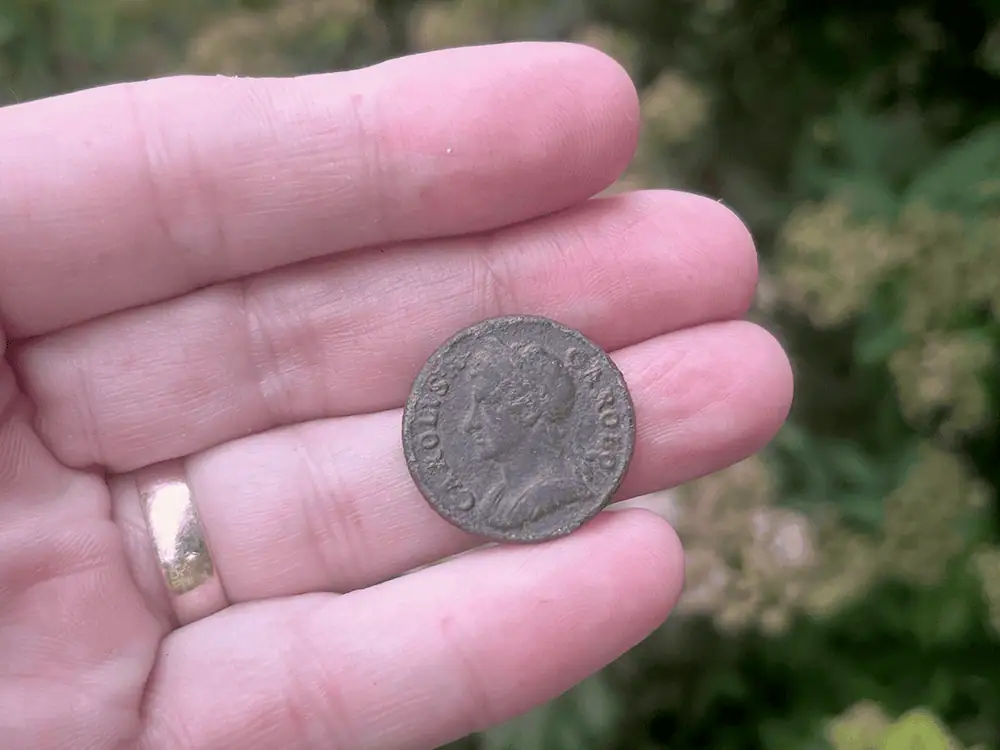
This copper farthing of Charles II was discovered by Murray in the Surrey Hills. It gave off a cracking signal (94 on his Equinox 900) and on unearthing it, he first thought it might be a Roman coin, the busts on Charles II’s coinage often resemble classical portraits. Although not Roman, the discovery was no less exciting: nearly 400 years old and a fine example of one of Britain’s earliest milled coins.
Farthing coins were the smallest denomination in circulation, essential for everyday purchases such as food, drink and other small goods. Under Charles II, England adopted mechanised minting on a large scale, replacing the irregular hammered coins of earlier centuries. These new milled coins, struck by machine, had uniform edges and designs that made them more difficult to clip or counterfeit.
The obverse carried the laureate head of Charles II, while the reverse showed Britannia seated with shield and spear, the first time Britannia appeared on British coinage, a symbol that continues today.
Though small in value, this farthing represents a significant step in the history of English money. Found in the quiet fields of Surrey, it connects us to the everyday transactions of people living through the Restoration era.
0 Comments