
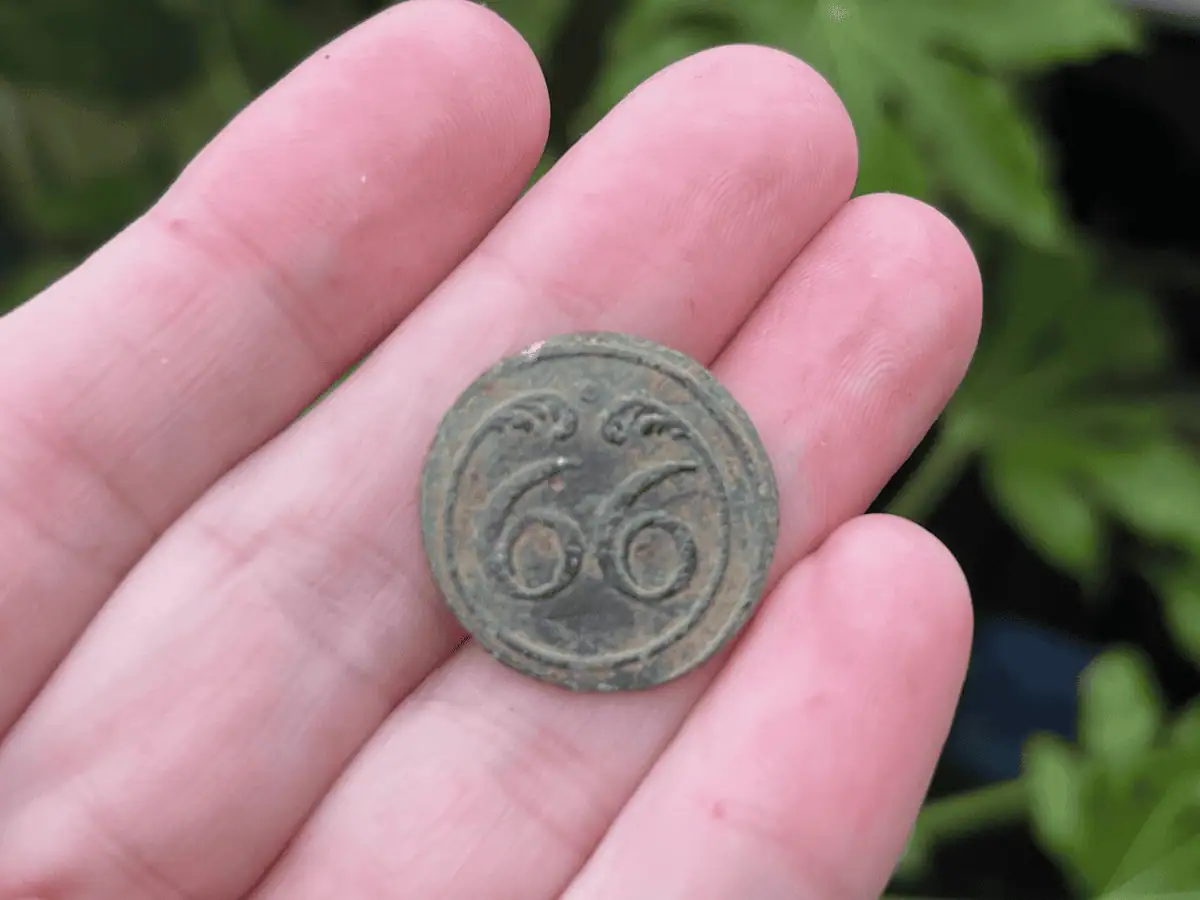
This military button of the French 66th Line Infantry Regiment, dating to the Napoleonic Wars (1796–1815), was discovered by Yanne while metal detecting at Godalming, Surrey. At first glance a small and unassuming object, the button carries with it a deeply human story tied to one of Europe’s most turbulent periods.
The button bears a bold number “66” at its centre, enclosed within a decorative curlicued border. Such buttons were worn on the uniforms of France’s line infantry, the backbone of Napoleon’s armies and would have been a familiar sight on battlefields across Europe during the early nineteenth century.
Its presence in rural Surrey is unlikely to be accidental. During the Napoleonic Wars, thousands of French soldiers were captured by British forces and transported to Britain as prisoners of war. Many were housed in large prison depots, but others were assigned to agricultural labour, working on farms and estates across the countryside to help offset wartime labour shortages. Godalming and the surrounding Surrey landscape, with its patchwork of fields and farmland, would have been a fitting, if unfamiliar, setting for such enforced work.
It is most likely that this button was lost from the uniform of one such prisoner, perhaps during long days of manual labour or quiet moments spent far from home. The separation from his regiment, his country, and his family would have been profound. For many prisoners, captivity was marked by uncertainty, hardship, and an unending hope for release.
This small artefact stands as a poignant reminder of the human cost of war, not just those who fought and fell on the battlefield, but those who endured capture, displacement, and years of waiting. As it lay forgotten in the Surrey soil, the land silently preserved a trace of one individual’s interrupted life.
More than two centuries later, this button invites reflection. We can only hope that its owner survived captivity, returned home, and was reunited with his loved ones. In rediscovering it today, Surrey gives voice once more to a story of loss, endurance, and quiet resilience hidden beneath its fields for generations.
0 Comments