
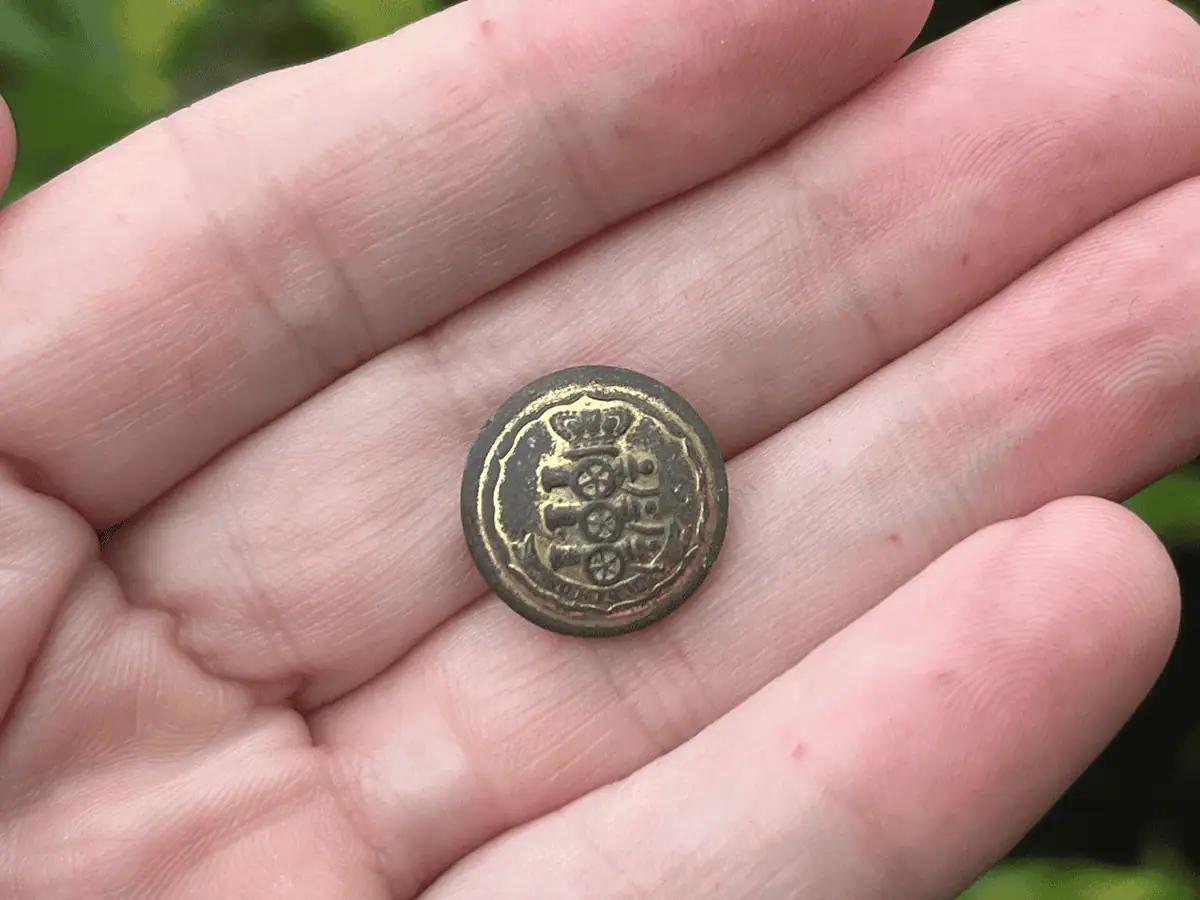
This small gilded copper alloy Royal Artillery button was discovered by Ashley while metal detecting in the Surrey Hills. Though only a modest object, it is a striking survival, still retaining traces of its original gilding and carrying with it the quiet presence of military life in the late Georgian period.
The button bears the familiar Royal Artillery device, a field cannon surmounted by a crown, with cannonballs arranged beneath. This emblem was widely used on artillery uniforms from the eighteenth century onward and is particularly evocative of the era of the French Revolutionary and Napoleonic Wars. On stylistic grounds, and considering its size and finish, this example most likely dates to the late eighteenth to early nineteenth century, circa 1790 to 1820.
Its small diameter suggests it was not a large coat button but one intended for finer parts of a uniform such as cuffs, lapels, or a waistcoat. The surviving gilded finish is especially telling. Gilded buttons were typically associated with officers, who purchased their own uniforms and often selected higher quality fittings, while ordinary ranks more commonly wore plainer brass or pewter examples. It seems likely, therefore, that this button once belonged to an officer, perhaps from an undress uniform worn on duty, on the move, or during everyday wear.
The Surrey Hills may feel far removed from artillery batteries and military parades, yet Surrey sat close to the strategic heart of Britain. During the Napoleonic era, troops moved constantly through the south of England, training, marching, and preparing amid invasion fears and wartime mobilisation. Surrey’s open countryside and well used routes between towns, camps, and the capital would have seen soldiers and officers alike passing through, their lives threaded into the same landscapes we walk today. You can read the article about the Box Hill Mobilisation Centre which is contemporary to this button.
Lost perhaps during a march, an exercise, or a simple moment of travel, this button would have been a minor inconvenience at the time, easily replaced. Centuries later, it becomes something far more personal, a small fragment of service and responsibility, preserved in the Surrey soil until it could be found again.
0 Comments